
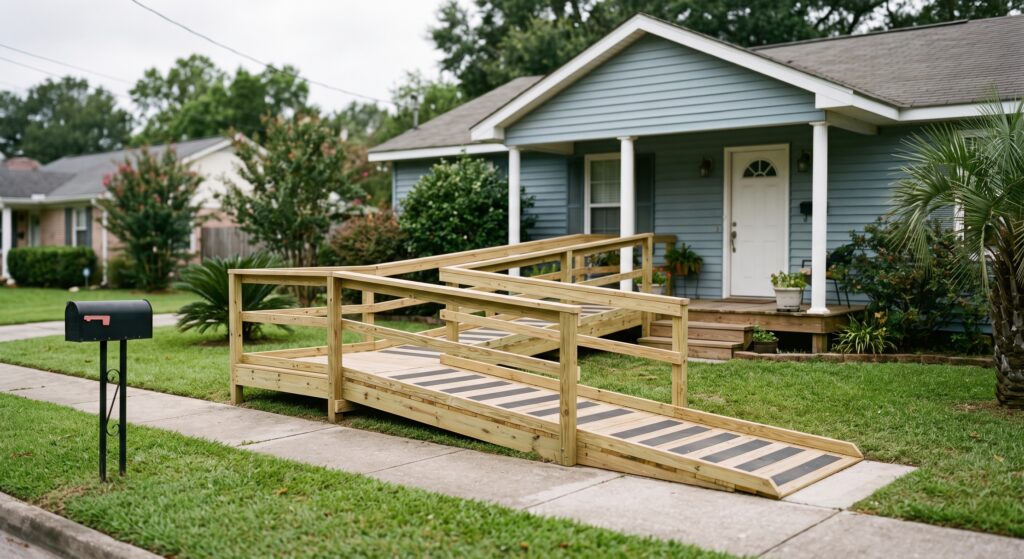
Yes, certain Louisiana Medicaid waiver programs may pay for a wheelchair ramp when the modification meets the requirements of that specific waiver.
However, wheelchair ramps are not a general Louisiana Medicaid benefit available to every Medicaid member.
Louisiana Medicaid’s standard Durable Medical Equipment (DME) benefit specifically identifies environmental modifications, including home modifications and ramps, as items that are not covered through the DME program.
Instead, wheelchair ramps may be available through certain Home and Community-Based Services (HCBS) waivers as an Environmental Accessibility Adaptation, sometimes referred to as a home modification.
Which Louisiana Medicaid Waivers May Cover a Wheelchair Ramp?
Several Louisiana waivers currently include Environmental Accessibility Adaptations or similar home-modification services.
Children’s Choice Waiver
Louisiana’s Children’s Choice Waiver includes Environmental Accessibility Adaptations.
Current Louisiana Medicaid guidance identifies qualifying home adaptations such as:
- Portable or fixed ramps
- Grab bars
- Handrails
- Widened doorways
- Certain bathroom modifications
- Certain electrical or plumbing modifications necessary to accommodate disability-related equipment
The modification must be related to the participant’s needs and included in the applicable waiver planning and authorization process.
Children’s Choice is administered through Louisiana’s Office of Intellectual and Developmental Disability Supports (OIDD).
New Opportunities Waiver
The New Opportunities Waiver (NOW) also includes Environmental Accessibility Adaptations.
Louisiana Medicaid specifically identifies non-portable ramps among the types of modifications that may qualify.
The purpose of the modification must be to address the participant’s health, welfare or safety, or allow the participant to function with greater independence in the home or community.
NOW environmental modifications are subject to waiver requirements, authorization and applicable funding limits.
Residential Options Waiver
The Residential Options Waiver (ROW) includes Environmental Accessibility Adaptations as well.
Qualifying home adaptations may include:
- Ramps
- Grab bars
- Widening doorways
- Bathroom modifications
- Other disability-related accessibility modifications
The modification must be connected to the participant’s assessed need and authorized through the applicable waiver process.
Community Choices Waiver
For individuals receiving services through Louisiana’s Office of Aging and Adult Services (OAAS), the Community Choices Waiver (CCW) also includes Environmental Accessibility Adaptations.
Louisiana specifically identifies:
- Portable ramps
- Fixed ramps
- Widened doorways
- Grab bars
- Roll-in showers
- Other qualifying accessibility modifications
CCW uses a formal review process to determine whether a proposed home modification is necessary and appropriate under the waiver.
Do All Louisiana Waivers Pay for Ramps?
No.
This is an important distinction.
Louisiana’s Supports Waiver does not currently list Environmental Accessibility Adaptations among its waiver services.
The Adult Day Health Care Waiver also does not currently list home Environmental Accessibility Adaptations as a covered waiver service.
A participant should therefore not assume that because one Louisiana waiver pays for home modifications, every Medicaid waiver provides the same benefit.
Each waiver has its own service package.
What About Regular Medicaid or EPSDT?
A wheelchair itself may qualify as Durable Medical Equipment when Medicaid requirements are met.
A wheelchair ramp is different.
Louisiana Medicaid’s DME policy specifically identifies environmental modifications such as home modifications, bathroom modifications and ramps as non-covered through the DME program.
For children and young adults under 21, EPSDT provides broad Medicaid protections for medically necessary Medicaid services. However, families should not assume that EPSDT converts a home construction project such as a wheelchair ramp into covered DME.
For example, a child enrolled in the Children’s Choice Waiver may have a ramp considered through the waiver’s Environmental Accessibility Adaptation service instead.
The Medicaid benefit being used matters.
Does Someone Have to Use a Wheelchair for a Ramp to Be Covered?
Not necessarily.
Waiver Environmental Accessibility Adaptation services are generally based on the participant’s functional and disability-related accessibility needs, rather than simply whether the person owns a particular type of wheelchair.
The applicable waiver must determine whether the proposed ramp is necessary under its criteria.
Use of a wheelchair, power chair, walker or another mobility device may be relevant, but the presence of a mobility limitation does not automatically establish Medicaid coverage.
Can Medicaid Pay for Ordinary Home Repairs Along With the Ramp?
Generally, Medicaid waiver home-modification benefits are intended to pay for qualifying accessibility modifications, not ordinary home maintenance or renovation.
For example, waiver funding should not be assumed to cover unrelated:
- Roofing
- Flooring
- General remodeling
- Routine repairs
- Cosmetic improvements
- Improvements primarily benefiting the entire household
If additional work is necessary around the area where a ramp will be installed, the waiver must determine which portion of the proposed project qualifies under its Environmental Accessibility Adaptation rules.
Medicaid waivers should not be viewed as general home-improvement programs.
What If the Participant Rents Their Home?
A rental home does not necessarily prevent an accessibility modification.
Certain Louisiana waiver programs allow qualifying modifications to rental or leased property, but written landlord approval and other program approvals may be required before the work begins.
The requirements differ by waiver.
Participants who rent should therefore discuss the proposed modification through the applicable waiver process before making changes to the property.
Should You Build the Ramp First and Ask Medicaid to Reimburse You?
No.
If Medicaid waiver funding is being requested, participants and families should go through the applicable approval process before construction begins.
Depending on the waiver, the process may include:
- Identifying the accessibility need
- Including the modification in the Plan of Care or submitting a Plan of Care revision
- Completing an assessment or home-access evaluation
- Obtaining required bids or cost information
- Obtaining landlord permission when applicable
- Using an appropriately qualified provider or contractor
- Obtaining Medicaid, OIDD, OAAS or other required authorization before work begins
Paying for a ramp first does not guarantee that Medicaid will reimburse the cost afterward.
Does the Contractor Have to Meet Certain Requirements?
Waiver-funded accessibility work must comply with the requirements of the specific waiver.
Louisiana’s waiver manuals include requirements concerning areas such as:
- Medicaid provider qualifications
- Applicable contractor registration or licensing
- State and local building requirements
- Professional licensing when plumbing, electrical or other specialized work is involved
- Applicable building and housing codes
The exact requirements depend on the modification and waiver.
A participant should not select or begin work with a contractor based only on the assumption that Medicaid will later approve the project.
What Can a Support Coordinator Help With?
For participants enrolled in a waiver that includes Environmental Accessibility Adaptations, the Support Coordinator may help the participant navigate the applicable process.
Depending on the waiver, Support Coordination may include helping to:
- Identify the participant’s accessibility need
- Determine whether the participant’s waiver includes an Environmental Accessibility Adaptation benefit
- Address the need in person-centered planning
- Coordinate required assessments or documentation
- Assist with Plan of Care revisions when applicable
- Coordinate required bids or forms
- Explore other required funding sources
- Submit or coordinate the applicable authorization process
A Support Coordinator does not independently approve or deny a wheelchair ramp.
Final coverage and authorization decisions are made through the applicable Louisiana Medicaid, OIDD, OAAS or other authorized process.
The Bottom Line: Does Louisiana Medicaid pay for a wheelchair ramp?
Certain Louisiana Medicaid HCBS waivers may cover a qualifying wheelchair or accessibility ramp.
Current Louisiana waiver programs that include Environmental Accessibility Adaptations allowing qualifying ramps include:
- Children’s Choice Waiver
- New Opportunities Waiver (NOW)
- Residential Options Waiver (ROW)
- Community Choices Waiver (CCW)
However:
- Standard Louisiana Medicaid DME does not cover home ramps as Durable Medical Equipment.
- Not every Louisiana waiver includes a home-modification benefit.
- Coverage is not automatic simply because someone uses a wheelchair or has difficulty entering their home.
- The proposed modification must meet the requirements of the participant’s specific waiver.
- Assessment, documentation, Plan of Care and authorization requirements may apply.
- Rental properties may require landlord approval.
- Construction should not begin before the required authorization process is completed if Medicaid payment is expected.
Important Information: This article is provided solely for general educational and informational purposes. It is not medical, legal, construction, Medicaid eligibility, waiver eligibility, or benefits-planning advice. Nothing in this article determines that a particular participant, property, ramp, contractor or expense qualifies for Medicaid coverage or reimbursement.
Environmental Accessibility Adaptation requirements vary by waiver and may depend on the participant’s assessed needs, Plan of Care, available waiver funding, home ownership or rental arrangement, prior authorization, assessments, contractor qualifications, building requirements and other individual circumstances. Program requirements may change.
Participants and families should not purchase materials, hire a contractor, begin construction, or incur expenses with the expectation of Medicaid reimbursement until the applicable waiver review and authorization process has been completed.
Our agency is an independent Louisiana Support Coordination Agency and is not the Louisiana Department of Health, Louisiana Medicaid, OIDD, OAAS, a contractor, or another government agency. Support Coordination may assist participants with navigating applicable waiver processes but does not independently determine coverage, approve construction, select contractors, or guarantee Medicaid payment.